Key Takeaways
- Commercial freezer doors and cooler doors combine extreme insulation (R-32 to R-40 polyurethane core) with heated frames to prevent ice buildup at the door perimeter.
- Three families: walk-in cooler/freezer doors (insulated swing or sliding), glass cooler doors (refrigerated display reach-in), strip-curtain doors (PVC strip in front of an open opening).
- Stainless-steel hardware mandatory for food-grade, USDA-inspected facilities.
- Heated frames prevent ice buildup that would otherwise jam the door at the perimeter and break the thermal seal.
A commercial freezer door or cooler door is the most demanding door spec in your facility — it operates in -30 °C internal temperature against a 30 °C ambient (60-degree differential), wash-down food-grade environment, and constant ice-buildup pressure at the perimeter. Pick the wrong door and you're replacing it in 5 years; pick the right one and it runs 20-25 years with annual gasket replacement.
Walk-in cooler and freezer doors
For full-room walk-in coolers and freezers:
- Hinged swing — most common, single-leaf or double-leaf
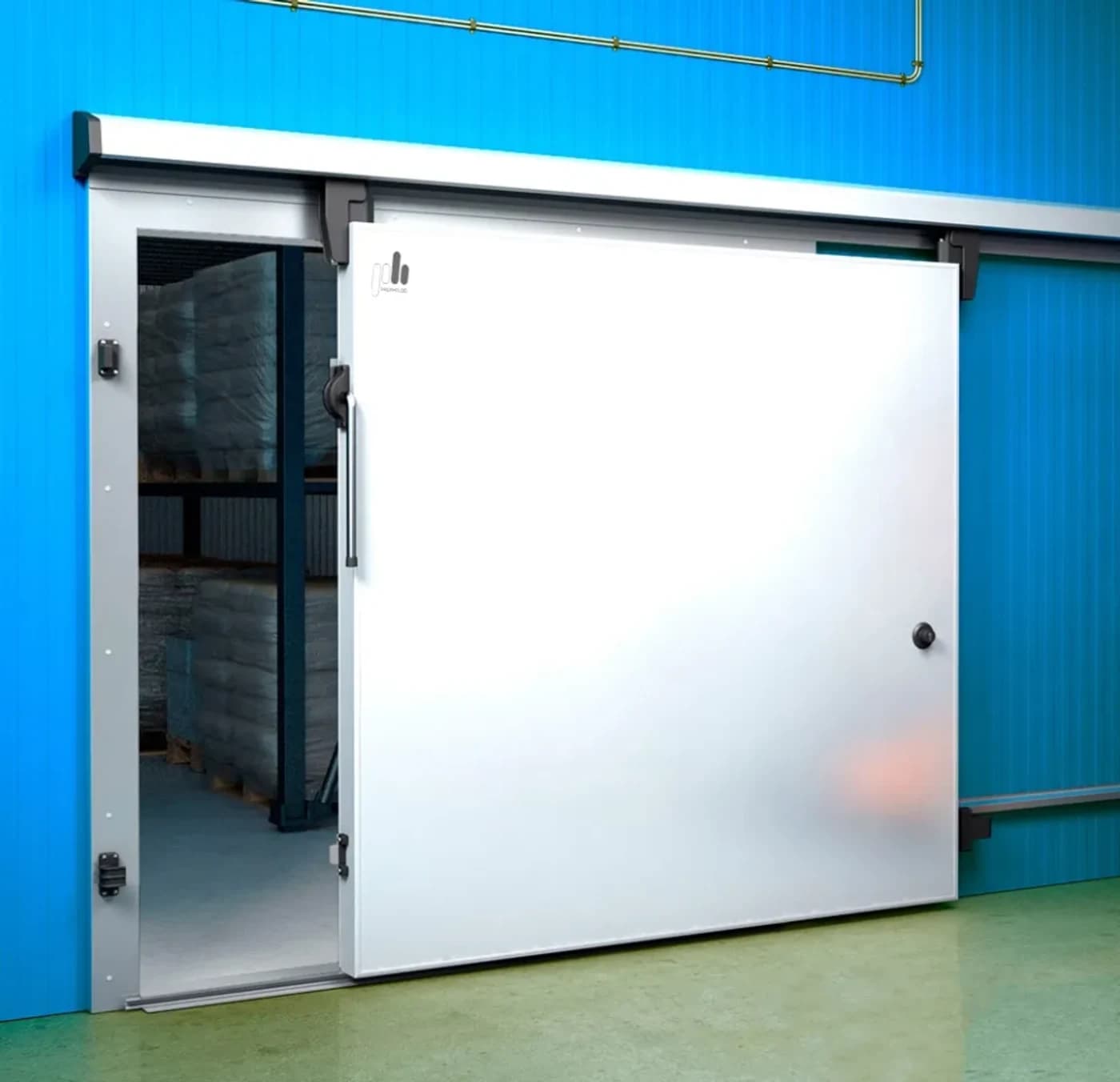
- Horizontal sliding — rides on a track above the opening; saves floor space; common in restaurant kitchen layouts
- Vertical-lift — opens overhead like a small overhead door; common in food-processing pass-throughs
Construction: 4-inch polyurethane sandwich core (R-32) for cooler, 6-inch polyurethane sandwich core (R-40) for freezer. Stainless-steel skin (food-grade) or galvalume (warehouse-grade). Heated frame (110V or 220V resistance heater) prevents ice buildup at the perimeter.
Glass cooler doors (display reach-in)
For refrigerated retail display: convenience-store cooler runs, grocery dairy/beverage displays, restaurant beer-cave doors. Configurations:
- Single-pane tempered — basic refrigerated display, R-2 thermal
- Double-pane sealed unit — better thermal, R-4 with argon fill
- Triple-pane sealed unit — premium refrigerated display, R-6+
- Anti-fog electric heating — embedded resistance wires prevent condensation/fog
Frame: aluminum or stainless steel. Hinges: lift-off cam or torsion-spring. Pulls: tubular handles or recessed grips.
Strip-curtain doors (cold-storage perimeter)
PVC strip curtains hung in front of an open cold-storage entry. Cheaper than a full insulated door, less thermal-effective. Common at:
- Walk-in cooler entries with high foot-traffic (restaurant kitchen pass-throughs)
- Cold-storage warehouse perimeter where forklift traffic is constant
- Loading-dock cold-storage where speed matters more than perfect seal
Construction: 8-inch or 12-inch PVC strips, low-temperature rated to -30 °C, stainless mounting hardware.
Frequently Asked Questions
What R-value do I need for a freezer door?
R-32 minimum for walk-in cooler (operating temperature 0 °C to 4 °C). R-40 minimum for walk-in freezer (operating temperature -18 °C to -30 °C). Lower R-value works but the cooling system runs harder, energy bills rise, and condensation forms on the door surface.
Do I need a heated frame?
In Canadian climates, yes — for any cooler or freezer with a 30 °C+ temperature differential. Without a heated frame, ice forms at the perimeter where the cold door surface meets the warm room air, eventually breaking the gasket seal and jamming the door. Heated frames are 110V or 220V perimeter-resistance heaters, typically drawing 50-200 watts per door.
How long do freezer doors last?
15-20 years on the door itself with annual gasket replacement and bi-annual hinge lubrication. Glass cooler doors: 8-12 years before the sealed-unit fogs (replace as a unit). Strip curtains: 3-5 years before UV degradation requires replacement.
What's the lead time?
4-6 weeks for stock walk-in cooler/freezer doors in standard sizes; 8-12 weeks for custom sizes or food-grade stainless construction. Strip curtains: 1-2 weeks.
Related: Cold Storage Doors · Strip Curtains · Air Curtains · Loading Dock Doors