What we install
| Type | Application | Speed |
|---|---|---|
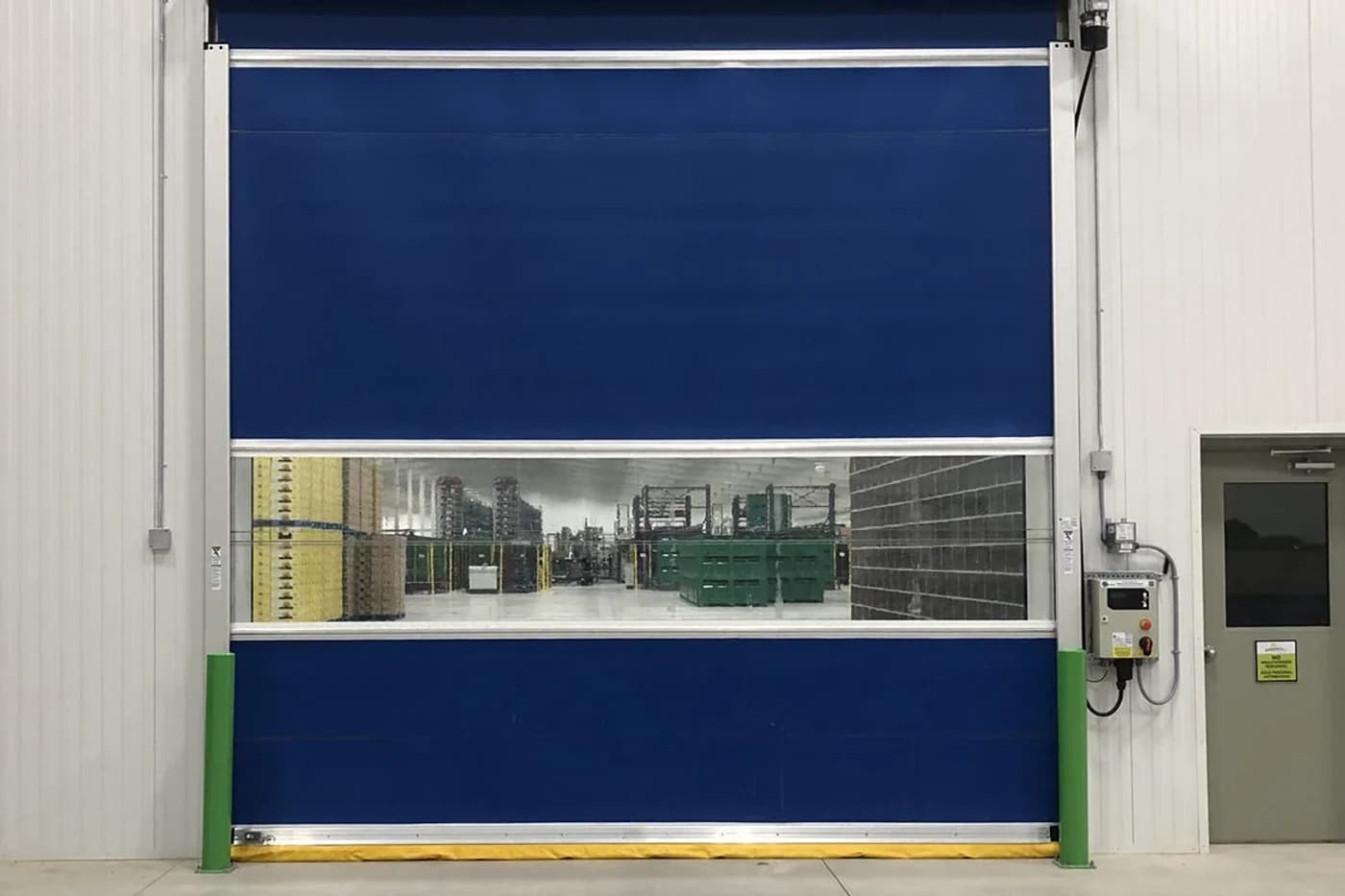
| Fabric high-speed roll-up | Distribution, manufacturing, food processing | 50-80 IPS |
| Rubber high-speed roll-up | Heavy-duty industrial, food washdown | 40-60 IPS |
| Rigid panel high-speed | Cold storage, clean room | 30-50 IPS |
| High-speed traffic door (PVC) | Forklift transitions between climate zones | 40-60 IPS |
| High-speed dock door | Loading-dock interfaces | 50-100 IPS |
Breakaway-and-self-repair — why it matters
The single biggest cost of high-speed doors at distribution centres is forklift impact. A standard sectional door takes a forklift hit and bends the track, kinks the panels, and goes out of service for a 4-8 hour repair. Breakaway high-speed doors separate the curtain from the side guides on impact, the curtain falls clean, the forklift drives through, and the door self-repairs on the next cycle — often within seconds, with no service call. Modern high-speed roll-up doors include this as standard.
Cold-storage and clean-room variants
For cold-storage applications, high-speed doors include insulated curtains (R-12 to R-20) with double-layer thermally broken construction and anti-condensation heater wires in the side guides. For clean-room applications, stainless-steel side guides and headboxes plus filtered side seals prevent particulate ingress.
Also called
High-speed-door specs and tenders use a range of names: high speed door, high speed doors, high-speed door, high-speed doors, rapid door, rapid doors, rapid door systems, rapid roller door, rapid roller doors, rapid roller shutter doors, pvc high speed door, high speed door services, and brand-specific terms like high-speed-door brand, industrial high-speed door, and European high-speed doors. We supply rigid-blade and fabric-curtain configurations cycling 60–120 inches per second, sized to dock-traffic counts and energy-recovery targets.