Key Takeaways
- A commercial door operator is the motor + control system that actuates the door — sized to actual cycle count, opening size, and door weight.
- Categories: commercial garage door operator (overhead doors), automatic door operator (sliding/swing entrance doors), power door operator (low-energy retrofit), handicap door operator (accessibility-driven).
- Cycle ratings: light commercial (25,000 cycles), standard commercial (100,000 cycles), heavy commercial (300,000+ cycles), continuous-duty (1,000,000+ cycles).
A commercial door operator is what makes a heavy commercial door usable — without one, the door is functional but slow, manual, and prone to back injuries from operator strain. We supply, install, and service every operator class sold in Canada — chain-hoist, jackshaft, and trolley for overhead doors; sliding, swing, and low-energy for pedestrian entrances.
Commercial garage door operators
For sectional and rolling steel overhead doors:
- Trolley (LCO) — chain or belt drive along an overhead rail; common for sectional doors in commercial shops
- Jackshaft (HCS) — wall-mounted at the side of the door, drives the torsion shaft directly; required when overhead headroom is limited
- Hoist (HCM) — heavy-duty for rolling steel and large sectional doors
- Continuous-duty — 1M+ cycle ratings for distribution centres and high-speed industrial applications
Sized by cycle count: 25-50 cycles/day = light commercial; 50-200 cycles/day = standard; 200-500/day = heavy; 500+/day = continuous-duty motor required.
Automatic door operators
For automatic sliding and swing entrance doors:
- Full-energy sliding (ANSI A156.10) — broad commercial lineup, strongest Canadian parts inventory
- Premium full-energy sliding — extended cycle ratings
- Telescopic sliding — wide-opening geometry, very low-maintenance
- Hermetic / ICU sliding — heavy-duty spec, hospital-grade
- Integrated access-control sliding — full-line, access control built in
- Swing operators (full-energy) — common in retail and corporate
- Low-energy swing (ANSI A156.19) — North-American manufacture, fast Canadian lead times
ANSI standard determines installation: A156.10 (full-energy, high-traffic) or A156.19 (low-energy, accessibility retrofit).
Power door operators (low-energy)
A power door operator is the low-energy version of a swing-door operator — used for accessibility retrofit on existing manual doors without requiring sensor mat or beam array (the door inherently moves slowly enough not to injure on contact). Common at washroom doors, vestibule doors, and back-of-house corridors.
ANSI A156.19 compliance is automatic with low-energy operators; ANSI A156.10 (full-energy) requires safety-sensor array.
Handicap door operators
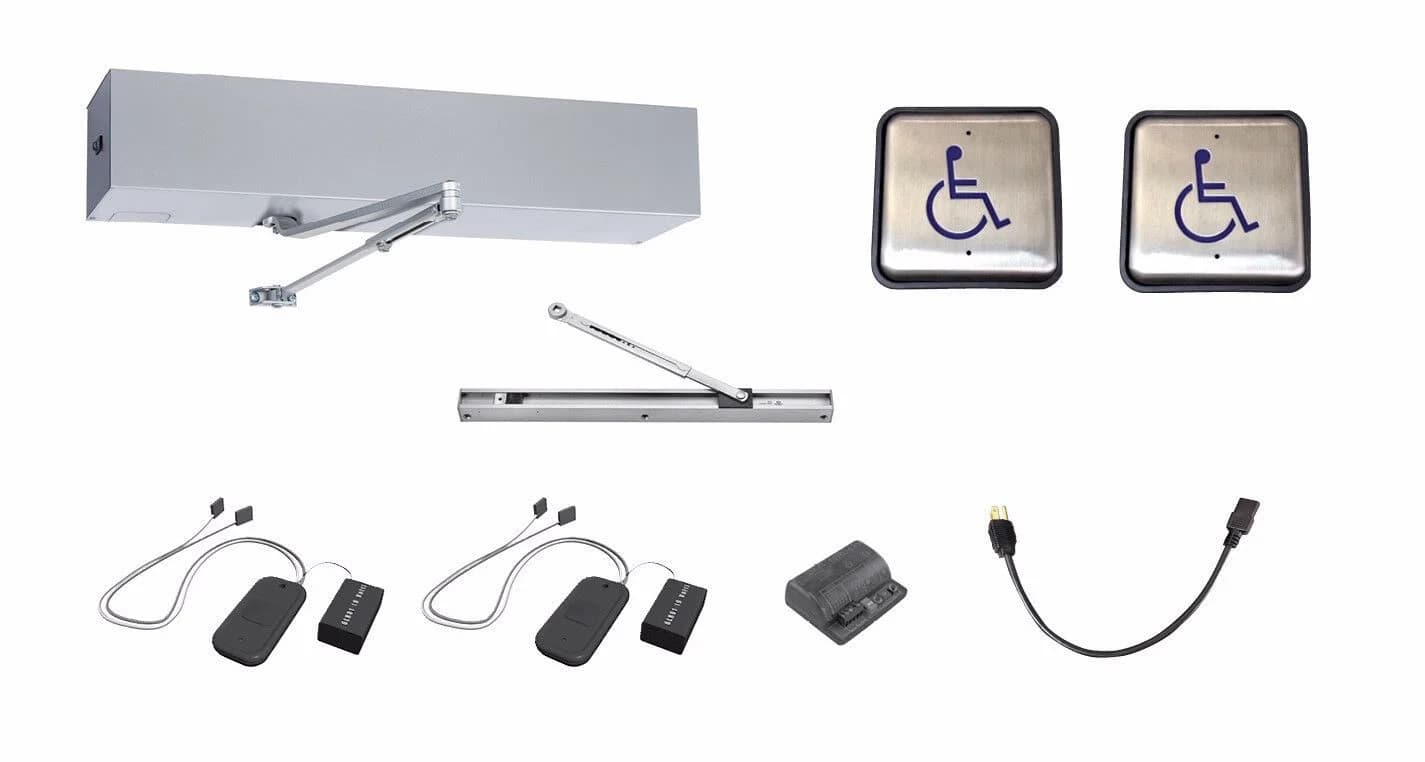
A handicap door operator is functionally a power door operator with a wireless or hard-wired actuation switch (usually a 4-inch round push-pad on a bollard) at appropriate height for wheelchair access. CSA B651 specifies the activation height (800-1,100 mm AFF) and reach (200-450 mm from edge). Provincial accessibility codes (AODA in Ontario, BCBC accessibility section in BC) reference CSA B651.
Frequently Asked Questions
How do I size a commercial garage door operator?
Three factors: door weight (gauge × area), opening size, and cycle count. We size to the next-larger cycle rating above measured cycle count to avoid premature operator failure — under-sizing is the #1 cause of operator burnout in Canadian commercial applications.
What's the difference between a commercial and a residential operator?
Residential operators are 1/2 to 3/4 HP, rated for ~10,000 cycles, with light-duty chain or belt drive. Commercial operators are 1/2 to 5 HP, rated for 25,000 to 1M+ cycles, with heavy-duty hoist or jackshaft drive plus integrated safety controls (entrapment protection, photo-eye, edge sensor). Residential operators installed in commercial applications fail at 18-30 months.
Do you service operator brands you didn't install?
Yes. We service every commercial operator brand sold in Canada. Service truck inventory covers the most common overhead and sliding operator control boards, sensors, and belts. Less common and legacy operators may require a parts order with 3-5 day return service.
What's the typical operator lifespan?
7-10 years for standard commercial operators with proper maintenance. High-speed and continuous-duty operators: 5-7 years before major rebuild. Annual safety certification (AAADM) is mandatory for automatic-entrance operators in Canada.
Related: Door Hardware & Operators · Automatic Doors · Overhead Doors · Automatic Sliding Doors